
Introduction
India has established itself as one of the world’s leading hubs for PVC additives, supplying high-quality PVC stabilizers to customers across Asia, Europe, the Middle East, Africa, and the Americas. Competitive manufacturing costs, technical expertise, advanced production facilities, and increasing investments in research have made Indian manufacturers preferred sourcing partners for global PVC processors.
However, selecting a PVC stabilizer manufacturer is no longer just about comparing prices. International buyers today must ensure that their suppliers can consistently meet evolving regulatory requirements, maintain product quality, support technical development, and deliver reliable supply at scale. A poor supplier choice can lead to inconsistent processing, rejected export shipments, regulatory issues, higher production costs, and dissatisfied end customers.
Whether you manufacture uPVC pipes, CPVC fittings, window profiles, wires and cables, or rigid packaging, choosing the right stabilizer supplier is a strategic business decision. This guide outlines the critical factors
procurement teams should evaluate when selecting a bulk PVC stabilizer manufacturer in India for global compliance.
Why Global Compliance Should Be Your First Consideration
Global regulations governing PVC additives have become significantly stricter over the last decade. Governments and certification bodies increasingly demand safer, environmentally responsible formulations with full traceability and documented quality systems. As a result, buyers can no longer rely solely on supplier claims—they must verify compliance through certifications, technical documentation, and consistent quality standards.
Manufacturers supplying products to international markets should look for stabilizer suppliers that support:
● REACH compliance
● RoHS requirements
● NSF certification (where applicable)
● ISO 9001 Quality Management Systems
● Lead-free stabilizer technologies
● Batch traceability and regulatory documentation
Working with a compliant supplier reduces regulatory risks, simplifies customer approvals, and strengthens confidence throughout the supply chain.
Evaluate the Manufacturer’s Production Capabilities
A manufacturer’s production infrastructure directly impacts product consistency and delivery reliability. While many suppliers may claim large capacities, buyers should assess how efficiently and consistently those facilities operate.
Modern manufacturing plants equipped with automated batching systems, controlled raw material handling, and advanced process monitoring produce far more consistent formulations than facilities relying heavily on manual operations. Automation minimizes human error, improves formulation accuracy, and ensures uniform product quality from batch to batch.
It is equally important to understand the supplier’s production capacity and scalability. A manufacturer may be capable of meeting your current demand but struggle as your business grows. Ask whether they have multiple production lines, sufficient annual manufacturing capacity, and contingency plans to support unexpected increases in order volumes without affecting lead times.
Strong Research & Development Drives Better Performance
PVC processing conditions vary significantly depending on the application. A stabilizer that performs exceptionally well in pressure pipes may not be suitable for window profiles, foam boards, or wire insulation. This is why a manufacturer’s research and development capabilities are often the biggest differentiator.
Rather than simply supplying standard formulations, leading manufacturers invest in dedicated application laboratories that continuously optimize formulations for different processing conditions.
A well-equipped R&D centre helps customers by:
● Developing customized stabilizer formulations
● Improving processing efficiency
● Optimizing lubricant balance
● Enhancing thermal stability
● Reducing plate-out issues
● Supporting new product development
● Troubleshooting processing challenges
Manufacturers with strong technical teams become long-term development partners rather than just raw material suppliers.
Quality Control Should Go Beyond Final Product Testing
Many buyers only ask whether a supplier performs quality testing before shipment. In reality, quality assurance begins much earlier in the manufacturing process.
A robust quality management system includes inspection of incoming raw materials, continuous monitoring during production, and comprehensive testing of finished products. Every production batch should be traceable, with retained samples available for future reference if required.
Reliable manufacturers routinely evaluate parameters such as thermal stability, bulk density, moisture content, particle size distribution, color retention, fusion behavior, and mechanical performance. This systematic approach ensures consistent product quality and minimizes production issues at the customer’s plant.
Instead of asking, “Do you test your products?” buyers should ask, “How do you ensure consistency across every batch?”
Product Portfolio Matters More Than You Think
Many PVC processors prefer working with suppliers that can provide a complete range of additives rather than sourcing products from multiple vendors. This simplifies procurement, improves formulation compatibility, and reduces supply chain complexity.
A comprehensive product portfolio typically includes:
● Lead-based One-Pack Stabilizers
● Calcium Zinc Stabilizers
● Organic Stabilizers
● CPVC Stabilizers
● PVC Lubricants
● Processing Aids
● Acrylic Impact Modifiers
● MBS Impact Modifiers
● Specialty Polymer Additives
Partnering with a single technically capable supplier also makes formulation optimization much easier since all additives are designed to work together.
Technical Support Creates Long-Term Value
One of the biggest differences between commodity suppliers and strategic partners is the level of technical support they provide.
PVC processing conditions differ from one production line to another. Factors such as resin quality, filler loading, extrusion temperature, equipment design, and processing speed all influence stabilizer performance. As a result, customers often require formulation adjustments or troubleshooting support.
Instead of only supplying materials, experienced manufacturers assist customers with process optimization, plant trials, product selection, and formulation improvements. This collaborative approach helps reduce downtime, improve production efficiency, and minimize material wastage over time.
A supplier that actively supports your technical team often delivers far greater value than one offering only the lowest price.
Evaluate Export Experience and Global Supply Capabilities
Supplying international customers requires far more than manufacturing high-quality products. Export documentation, packaging standards, shipping schedules, customs regulations, and logistics planning all influence the customer experience.
Before finalizing a supplier, buyers should understand:
● Which countries does the manufacturer currently export to?
● How are products packaged for international shipments?
● Can they provide Certificates of Analysis (COA), Technical Data Sheets (TDS), Safety Data Sheets (SDS), and regulatory declarations?
● What are their average production and shipping lead times? ● How do they handle emergency or urgent orders?
Manufacturers (PVC stabilizer manufacturers – this keyword can be used) with established export operations generally have better systems in place for documentation, inventory management, and customer communication, making international procurement much smoother.
Sustainability Is Becoming a Procurement Requirement
Environmental responsibility has become a major purchasing criterion, particularly for multinational companies. Buyers increasingly expect suppliers to demonstrate sustainable manufacturing practices and offer formulations that align with global environmental regulations.
Important sustainability indicators include:
● Lead-free stabilizer technologies
● Environmentally responsible product development
● Energy-efficient manufacturing
● Responsible sourcing of raw materials
● Waste reduction initiatives
● Continuous investment in cleaner production processes
As more countries transition toward lead-free PVC formulations, Calcium Zinc stabilizers continue to gain importance due to their excellent processing performance and environmental benefits.
Documentation and Traceability Are Essential
International customers frequently undergo supplier audits, customer inspections, and regulatory reviews. During these evaluations, comprehensive documentation becomes just as important as product performance.
Professional manufacturers should readily provide:
● Technical Data Sheets (TDS)
● Safety Data Sheets (SDS)
● Certificates of Analysis (COA)
● Product specifications
● Regulatory compliance declarations
● Batch traceability records
Efficient documentation not only simplifies customs clearance but also strengthens customer confidence and supports faster product approvals.
Why Platinum Industries Is a Trusted Global Partner
When evaluating PVC stabilizer manufacturers in India, Platinum Industries Limited stands out through its combination of technical expertise, modern manufacturing infrastructure, and customer focused innovation.
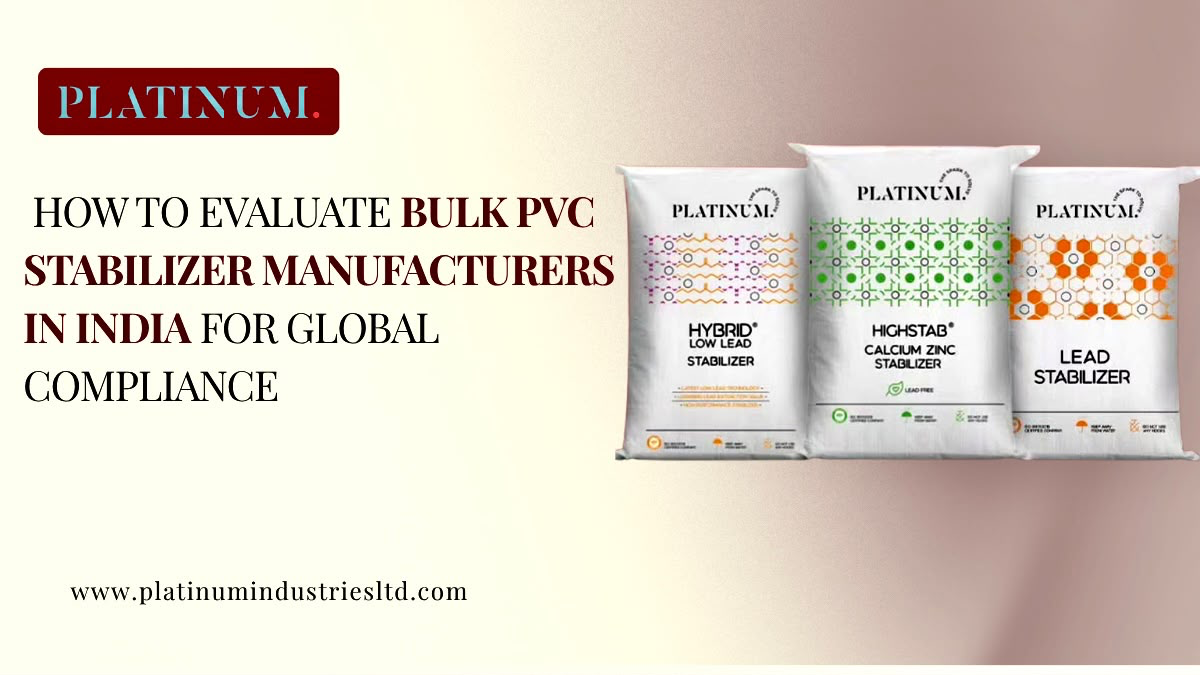
The company has built a comprehensive portfolio of PVC additives designed to serve a wide range of applications across the global plastics industry. Its product range includes Highstab™ Lead-Free Calcium Zinc Stabilizers Lead-Based One-Pack Stabilizers, Organic Stabilizers, CPVC additive solutions, PVC lubricants, impact modifiers, processing aids, and specialty polymer additives.
One of Platinum’s key strengths is its DSIR-recognized Research & Development Centre, where dedicated laboratories continuously develop customized formulations for different PVC processing applications. This allows customers to receive products specifically optimized for their manufacturing conditions rather than relying on generic formulations.
For manufacturers serving potable water applications, Platinum also offers NSF-certified UNIPACK™ formulations for CPVC pipes and fittings, providing additional confidence in regulated markets.
Platinum Industries’ competitive advantages include:
● Modern automated manufacturing facilities
● ISO-certified quality management systems
● NSF-certified UNIPACK™ solutions
● Customized formulation development
● Strong export presence across multiple international markets ● Comprehensive technical support
● Wide portfolio covering PVC and CPVC additive requirements
Whether customers require higher thermal stability, improved weatherability, enhanced processing efficiency, or customized formulations, Platinum works closely with processors to deliver solutions that improve productivity while meeting global quality standards.
Questions Every Buyer Should Ask Before Finalizing a Supplier
Before entering into a long-term supply agreement, procurement teams should evaluate potential suppliers using a structured checklist. Important questions include:
● Which international certifications do your products comply with?
● Can you provide REACH and RoHS compliance documentation?
● Do you manufacture both lead-based and lead-free stabilizers?
● Is your R&D team capable of developing customized formulations?
● How do you maintain batch-to-batch consistency?
● What quality tests are performed before dispatch?
● Can you support high-volume export requirements?
● What technical support do you offer after product supply?
● How do you ensure uninterrupted supply during fluctuations in demand?
● What documentation accompanies every shipment?
The answers to these questions often reveal far more about a supplier’s capabilities than pricing alone.
Conclusion
Choosing a bulk PVC stabilizer manufacturer is a long-term strategic decision that directly affects manufacturing efficiency, product quality, regulatory compliance, and customer satisfaction. While cost remains an
important consideration, global buyers should place equal emphasis on technical expertise, research capabilities, manufacturing infrastructure, quality assurance systems, sustainability initiatives, and export experience.
Indian manufacturers have become globally competitive by investing in innovation, automation, and regulatory compliance. Among them, Platinum Industries Limited has positioned itself as a trusted partner for PVC processors worldwide through its advanced Highstab™ Calcium Zinc Stabilizers, UNIPACK™ CPVC solutions, strong R&D capabilities, and commitment to delivering high-performance additives that meet international standards.
As global regulations continue to evolve, partnering with a technically competent and compliance-focused manufacturer will help businesses reduce operational risks, improve processing efficiency, and build a more resilient supply chain. For companies seeking a reliable supplier of bulk PVC stabilizers, selecting the right manufacturing partner today can create lasting value for years to come.