
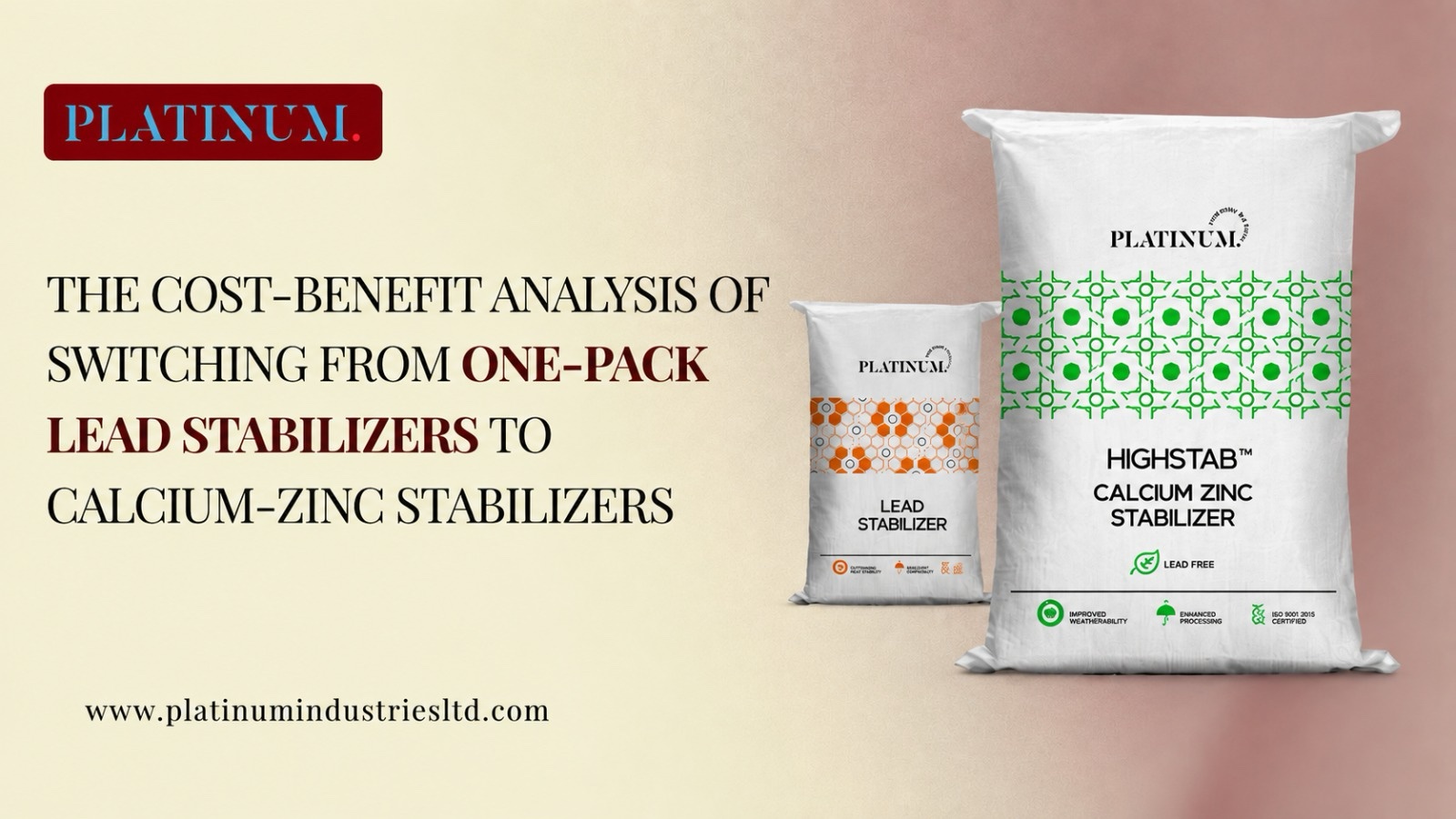
For decades, one-pack lead stabilizers have been the preferred choice for manufacturing rigid PVC products because of their excellent thermal stability, ease of processing, and cost-effectiveness. They have enabled manufacturers of pipes, fittings, profiles, conduits, and cables to achieve consistent processing performance while maintaining competitive production costs. However, the PVC industry today is witnessing a significant shift. Increasing environmental regulations, changing customer expectations, and the global movement toward sustainable manufacturing are encouraging processors to transition to lead-free PVC stabilizers, particularly Calcium-Zinc (Ca-Zn) Stabilizers .
While many manufacturers initially evaluate this transition based on the purchase price of the stabilizer, the true comparison extends far beyond the cost per kilogram. Factors such as product quality, operational efficiency, equipment maintenance, export compliance, customer acceptance, and long-term business sustainability all contribute to the overall return on investment.
This article examines the complete cost-benefit analysis of replacing conventional one-pack lead stabilizers with modern Calcium-Zinc stabilizers and explains why an increasing number of PVC processors worldwide are making the switch.
Why the Industry Is Transitioning Away from Lead Stabilizers
Lead stabilizers have long been recognized for providing excellent heat stability during PVC processing. Their ability to withstand high processing temperatures and maintain product performance made them the industry standard for many years. However, the presence of lead has become a growing concern due to its environmental and health implications.
Today, governments across Europe and several international markets have introduced stricter regulations on the use of heavy metals in plastic products. In addition to regulatory requirements, multinational OEMs, infrastructure projects, and global brands increasingly specify lead-free PVC formulations as part of their sustainability initiatives. As a result, manufacturers looking to remain competitive in domestic and export markets are actively evaluating alternatives that meet both technical and environmental expectations.
Among the available technologies, Calcium-Zinc stabilizers have emerged as the preferred solution due to continuous advancements in formulation science. Modern Ca-Zn stabilizers now deliver processing performance comparable to traditional lead systems while eliminating the environmental concerns associated with heavy metals.
Looking Beyond Cost Per Kilogram
One of the biggest misconceptions surrounding Calcium-Zinc stabilizers is that they are simply a more expensive alternative to lead stabilizers. While the initial formulation cost may be marginally higher depending on the application, evaluating only the raw material price provides an incomplete picture.
Manufacturers today increasingly assess additives based on their Total Cost of Ownership (TCO) rather than purchase price alone. Total production cost includes factors such as material wastage, processing efficiency, machine downtime, maintenance expenses, rejection rates, regulatory compliance, and customer satisfaction. When these elements are considered collectively, the economic advantages of Calcium-Zinc stabilizers become much more evident.
A stabilizer that improves production consistency, reduces scrap, and minimizes maintenance can generate significant savings over thousands of tonnes of annual production. Consequently, a slightly higher additive cost often translates into a lower overall manufacturing cost.
Improved Manufacturing Efficiency and Lower Rejection Rates
One of the most immediate benefits of modern Calcium-Zinc stabilizers is improved production consistency. Advanced formulations are designed to provide excellent dispersion throughout the PVC compound while maintaining stable processing behavior during long extrusion cycles. This helps manufacturers produce components with better surface finish, improved colour consistency, and reduced thermal degradation.
Stable processing directly influences product quality. Defects such as burn marks, black specks, uneven coloration, or surface imperfections are minimized, resulting in fewer rejected products and reduced reprocessing requirements. Even a small reduction in rejection rates can generate considerable savings for manufacturers operating high-volume extrusion lines.
Lower scrap generation also reduces raw material consumption and energy usage while improving production efficiency. These operational improvements contribute directly to profitability and often outweigh the marginal increase in stabilizer cost.
Reduced Maintenance and Higher Equipment Productivity
Machine reliability plays an equally important role in determining manufacturing costs. During continuous production, poorly optimized formulations may contribute to deposits inside screws, barrels, and dies, requiring frequent cleaning and maintenance shutdowns.
Modern Calcium-Zinc stabilizer systems are formulated to provide cleaner processing conditions with reduced plate-out and improved lubrication balance. Cleaner equipment allows extrusion lines to operate for longer production runs without interruption, increasing machine availability and reducing maintenance costs.
The financial impact extends beyond maintenance expenses alone. Fewer shutdowns mean higher production output, improved delivery schedules, and better utilization of manufacturing assets. Over time, these operational efficiencies significantly enhance the return on investment achieved through lead-free stabilizer technology.
Compliance Is No Longer Optional
Regulatory compliance has become a major factor influencing purchasing decisions throughout the PVC value chain. Products used in drinking water systems, medical applications, construction, and consumer goods increasingly require compliance with international environmental standards and customer-specific material specifications.
Manufacturers using lead-free formulations are better positioned to satisfy these requirements while reducing the administrative burden associated with hazardous material management. They can also respond more confidently to customer audits, sustainability assessments, and product certification requirements.
For companies serving export markets, compliance is no longer simply a legal obligation—it has become a competitive advantage. Customers increasingly prefer suppliers that demonstrate environmentally responsible manufacturing practices and long-term regulatory readiness.
Better Market Opportunities Through Lead-Free Manufacturing
Beyond regulatory compliance, adopting Calcium-Zinc stabilizers opens new commercial opportunities. Many global infrastructure projects, multinational manufacturers, and government procurement programs specify lead-free materials as part of their purchasing criteria.
PVC stabilizer manufacturers, capable of supplying lead-free PVC products are therefore better positioned to access premium markets, participate in international tenders, and build long-term relationships with global customers.
Sustainability has also become an important differentiator. Companies investing in environmentally responsible technologies strengthen their corporate reputation while supporting broader Environmental, Social, and Governance (ESG) objectives. This growing emphasis on sustainability continues to influence procurement decisions across industries.
Performance Comparison
| Parameter | One-Pack Lead Stabilizer | Calcium-Zinc Stabilizer |
|---|---|---|
| Thermal Stability | Excellent | Excellent |
| Colour Retention | Good | Excellent |
| Weather Resistance | Good | Superior |
| Heavy Metal Content | Contains Lead | Lead-Free |
| Export Compliance | Increasingly Restricted | Widely Accepted |
| Workplace Safety | Requires Additional Precautions | Improved Safety |
| Sustainability | Limited | Excellent |
Modern Calcium-Zinc stabilizers have evolved considerably over the last decade. Continuous improvements in formulation chemistry have enabled manufacturers to achieve excellent thermal stability, processing efficiency, weatherability, and mechanical performance without compromising productivity. For many rigid PVC applications, the performance gap that once existed between lead and lead-free systems has been substantially eliminated.
Highstab™ Calcium-Zinc Stabilizers from Platinum Industries
As manufacturers increasingly transition toward sustainable PVC processing, selecting the right stabilizer partner becomes just as important as selecting the stabilizer itself. Platinum Industries Limited has developed its Highstab™ Calcium-Zinc Stabilizer range to help processors achieve superior processing performance while meeting evolving environmental and regulatory expectations.
Backed by a DSIR-recognized R&D Centre, advanced manufacturing infrastructure, and decades of formulation expertise, Highstab™ stabilizers are engineered for consistent quality across a wide range of rigid PVC applications. The portfolio is suitable for uPVC and CPVC pipes, fittings, window profiles, electrical conduits, wires and cables, foam boards, and other technical profiles.
Highstab™ formulations deliver excellent thermal stability, consistent colour retention, superior weather resistance, optimized lubrication balance, and reliable processing characteristics that help manufacturers maintain productivity while transitioning to lead-free technology. Platinum’s technical experts also work closely with customers to optimize formulations, conduct processing trials, and customize stabilizer systems based on application-specific requirements. This collaborative approach minimizes transition time and ensures that processors achieve maximum operational efficiency without compromising product quality.
Conclusion
The decision to replace one-pack lead stabilizers with Calcium-Zinc stabilizers should not be viewed solely through the lens of raw material cost. Modern manufacturing demands greater attention to production efficiency, product consistency, regulatory compliance, sustainability, and long-term business competitiveness.
Although Calcium-Zinc stabilizers may involve a modest increase in formulation cost for certain applications, they often deliver substantial savings through reduced scrap, lower maintenance, cleaner processing, improved product quality, and expanded market opportunities. These operational and commercial benefits contribute to a lower total cost of ownership while preparing manufacturers for evolving global regulations and customer expectations.
For PVC processors seeking a future-ready stabilizer solution, Highstab™ Calcium-Zinc Stabilizers from Platinum Industries Limited offer the ideal balance of performance, compliance, and cost efficiency. Supported by advanced research capabilities, application expertise, and customer-focused technical service, Platinum helps manufacturers transition confidently toward safer, sustainable, and high-performance PVC production.