
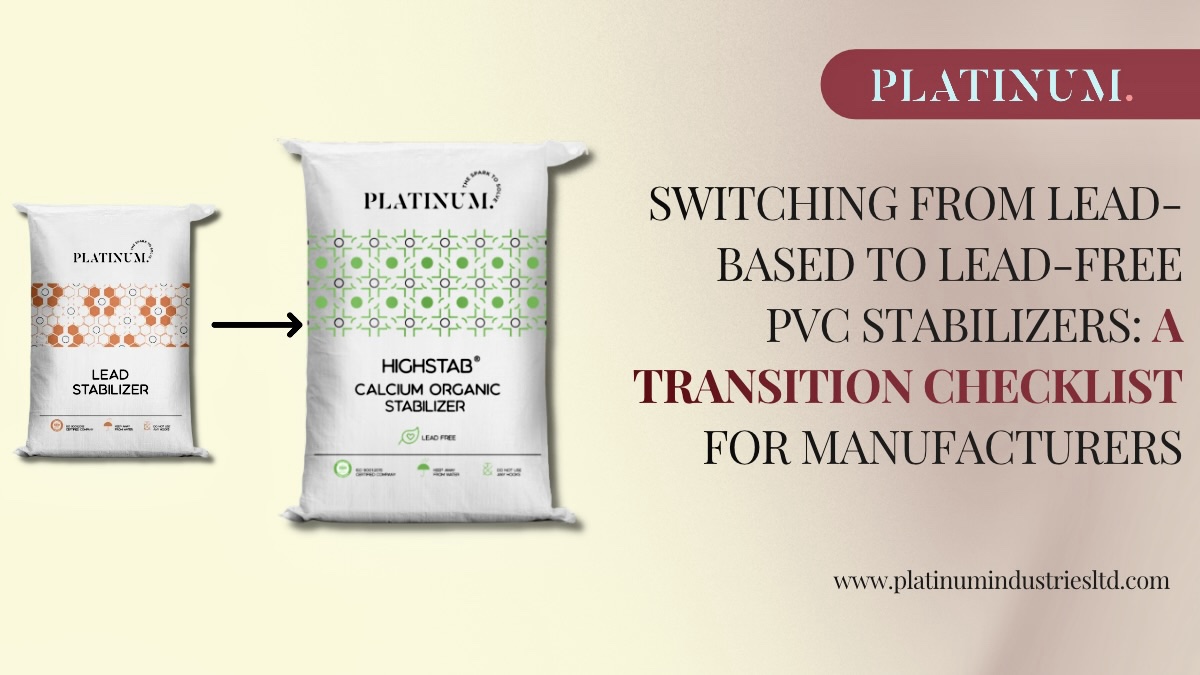
Regulatory pressure, buyer specifications and sustainability targets, hazard awareness are pushing PVC processors away from lead. Pipes, profiles, cables and sheets that once relied on lead-based systems now need lead-free PVC stabilizers that keep the same thermal stability, output and mechanical performance.
Regulatory pressure, buyer specifications and sustainability targets, hazard awareness are pushing PVC processors away from lead. Pipes, profiles, cables and sheets that once relied on lead-based systems now need lead-free PVC stabilizers that keep the same thermal stability, output and mechanical performance.
The switch is not a like-for-like swap. Lead stabilizers are chemical additives robusts : they scavenge HCl, cover a wide processing window, and tolerate variations in resin quality, filler, and lubricant. Lead-free systems, mainly calcium zinc (Ca-Zn) and calcium organic (Ca-Org) chemistries, work differently and need a more deliberate approach.
This checklist walks manufacturers through the transition from the first formulation review to full-scale production.
Why Manufacturers Are Moving Away from Lead
Three forces are driving the change:
- Regulation. Restrictions on lead in PVC are tightening in many markets, and regional rules vary. Confirm the current requirements for every market you sell into.
- Customer and tender requirements. Infrastructure buyers, OEMs and export customers increasingly specify lead-free compounds.
- Worker and environmental safety. Handling lead dust adds occupational health obligations and disposal costs, and it complicates recycling of end-of-life PVC.
Lead-free stabilizers are non-toxic and suit applications where safety and sustainability matter, while still protecting PVC against heat, UV and environmental stress. Done properly, they also improve color stability and surface quality.
Step 1: Audit Your Current Formulation and Process
Before you change anything, document your baseline. You cannot judge a new system without knowing what “good” looks like today.
- Record the complete recipe in phr: resin K-value, stabilizer dosage, calcium carbonate loading, lubricants, impact modifier, processing aid and pigment.
- Log processing parameters: barrel and die temperatures, screw speed, torque, output rate and melt pressure.
- Capture finished-product benchmarks such as impact strength, tensile properties, Vicat softening point, surface finish and color.
- Note current pain points such as die build-up, plate-out or variation between resin lots.
This baseline becomes your acceptance criteria.
Step 2: Choose the Right Lead-Free Chemistry
Not every lead-free system suits every product.
Calcium zinc stabilizers are the most widely adopted replacement. They balance HCl scavenging (calcium) with early color control by inhibit degradation (zinc), and they suit pipes, fittings, profiles, cables and sheets. Their weakness is “zinc burning,” a sudden blackening when zinc chloride builds up. Good formulations manage this with co-stabilizers and costabilizing organics.
Calcium organic stabilizers contain no zinc. They can improve long-term stability and reduce the zinc-burning risk in demanding, high-temperature or long-residence-time processes.
Platinum Industries offers both routes under its Highstab™ lead-free range: Highstab™ Calcium Zinc Stabilizers and Highstab™ Calcium Organic Stabilizers. Having both in one portfolio lets you match the chemistry to the application instead of forcing one system to fit everything. You can explore the full lead-free stabilizer range on their site.
Step 3: Rebalance the Lubricant Package
This is where many transitions fail. Lead stabilizers, particularly lead sulfates and stearates, contribute their own lubrication. Lead-free systems generally do not, so the internal/external lubricant balance must be rebuilt.
- Too little external lubrication leads to sticking, hot spots and degradation.
- Too much causes slippage, lower physical properties, reduced output, plate-out and poor fusion.
- Fusion behavior shifts. Ca-Zn compounds often fuse differently, so verify fusion time and torque on a rheometer.
Platinum’s lubrication portfolio supports this rebalancing:
- Platilub internal and external lubricants, plus antistatic and slip additives.
- Platimax PE waxes and micronised PE waxes, including Lubpack lubricant one-packs.
- Metal soaps such as calcium, zinc and magnesium stearates, which act as co-stabilizers and lubricants.
Working with a supplier that provides the stabilizer and the lubricant system removes a common source of finger-pointing during trials.
Step 4: Review Fillers, Impact Modifiers and Processing Aids
Lead-free stabilizers interact differently with the rest of the compound, so check these components:
- Calcium carbonate. Coating quality and moisture affect stability and dispersion. Poorly coated or damp filler can trigger defects more visibly in lead-free systems.
- Impact modifiers. Confirm impact performance at your target loading. Platinum’s Platimpact range includes MBS and acrylic impact modifiers.
- Processing aids. These promote fusion and melt strength, especially in filled or high-output formulations. See Platiaid processing aids and foam regulators.
- Pigments and TiO₂. Some pigments interact with zinc or affect weathering. Retest color and UV performance.
Step 5: Run Laboratory Trials Before Touching the Line
Simulate production before committing material and machine time. A solid lab program includes:
- Two-roll mill / Congo Red test to compare static thermal stability against your lead-based baseline.
- Dynamic thermal stability and rheometer runs to study fusion time, torque and stability time under shear.
- Oven aging (static heating) to watch color development over time.
- Dosage ladder trials. Test the stabilizer at several levels to find the cost-performance optimum instead of over-dosing to be safe.
- Mechanical testing on pressed or extruded samples.
A supplier with a dedicated development lab can shorten this stage considerably. Platinum Industries is a DSIR-recognized R&D lab, which matters when you need technical support with formulation troubleshooting.
Step 6: Plan the Extrusion Trial
Once lab data looks good, move to the line. Practical guidance:
- Clean the line thoroughly. Residual lead compound can contaminate a lead-free product and undermine compliance claims. Purge screws, barrels and dies, and clean hoppers and blenders.
- Start with a conservative temperature profile, then tune. Lead-free compounds often prefer slightly different profiles.
- Watch torque, melt pressure and output against your baseline.
- Inspect the die after extended runs for build-up, and check the product for surface streaks or discoloration.
- Run long enough. A 30-minute trial hides problems that appear after several hours, especially plate-out and gradual zinc-related discoloration. Aim for a full shift.
- Test the finished product against standards for your application and market.
Involve your stabilizer supplier’s technical team during this trial. Real-time adjustments to lubricant balance or dosage save days of iteration.
Step 7: Address Regrind and Recycling
Manufacturers often reuse regrind or in-house scrap. Mixing lead-containing regrind into lead-free product can compromise compliance, while lead-free regrind reprocessed several times consumes stabilizer. Decide your regrind policy early, segregate lead-containing scrap, and adjust stabilizer dosage where recycled content is high.
Step 8: Update Documentation, Compliance and Traceability
A successful trial is not the end. Before commercial launch:
- Update your bills of materials, batch records and quality plans.
- Collect supplier compliance documentation and test reports for the stabilizer.
- Run third-party heavy-metal tests on finished goods if customers or tenders require it.
- Train operators and QC staff on the new process window and defect signatures.
- Communicate the change to customers and update product datasheets.
Step 9: Manage the Transition Commercially
Lead-free systems often look pricier per kilogram, but total cost of ownership tells a fuller story. Consider:
- Optimized dosage and one-pack convenience.
- Reduced compliance and handling costs.
- Access to lead-free-only markets and tenders.
- Lower waste through better process control.
If you cannot switch all lines at once, a phased approach is reasonable. Platinum also offers Hybrid Low Lead™ within its stabilizer portfolio, which can help operations that need an intermediate step. For full lead-free compliance, the Highstab™ range is the destination.
Quick Transition Checklist
- Document the current formulation, process window and quality baseline
- Select Ca-Zn or Ca-organic chemistry to match the application
- Rebuild the lubricant system (internal/external balance)
- Check filler quality, impact modifier and processing aid compatibility
- Complete lab testing: Congo Red, rheometry, oven aging, dosage ladder
- Clean the line to avoid lead cross-contamination
- Run a full-shift extrusion trial and inspect die and product
- Define regrind and scrap segregation rules
- Update documentation, compliance records and operator training
- Validate commercial economics and plan the rollout
Why Partner with Platinum Industries
Switching stabilizer systems is as much about technical support as it is about the product. Platinum Industries is a global manufacturer of specialty polymer additives serving customers in 30+ countries, with a portfolio that spans PVC stabilizers, CPVC additives, lubricants, metal soaps, impact modifiers and processing aids. That breadth means you can source the stabilizer, lubricant and modifier package from one technically aligned supplier instead of coordinating several.
Combined with in-house R&D and both lead-free routes under Highstab™, Platinum is well placed to support manufacturers through each step above.
FAQs
What is the difference between lead-based and lead-free PVC stabilizers?
Lead-based stabilizers use lead compounds to scavenge HCl and protect PVC during processing. Lead-free stabilizers, typically calcium zinc (Ca-Zn) or calcium organic systems, achieve similar thermal protection without heavy metals, making them compliant with modern environmental and safety regulations.
Why are manufacturers switching to lead-free PVC stabilizers?
Manufacturers are transitioning due to tightening regulations on heavy metals, buyer and tender requirements for lead-free compounds, and the need to reduce occupational health risks from lead dust during handling and processing.
Is calcium zinc stabilizer as effective as lead-based stabilizer?
Calcium zinc (Ca-Zn) stabilizers deliver comparable thermal stability, processing performance and finished-product quality when the formulation (especially the lubricant package and additives) is properly rebalanced for the new chemistry.
Does switching to a lead-free stabilizer require changing the entire PVC formulation?
Not entirely, but adjustments are usually needed. The lubricant system, filler quality, impact modifier dosage and processing temperatures often need rebalancing since lead-free stabilizers behave differently from lead-based ones.
What is “zinc burning” in calcium zinc stabilized PVC?
Zinc burning is a sudden discoloration (blackening) caused by zinc chloride buildup during processing. It’s managed through proper co-stabilizer selection, dosage control and formulation balance.
How long does a lead-based to lead-free stabilizer transition take?
Timelines vary by product and line complexity, but a typical transition includes lab trials (1–2 weeks), extrusion/line trials (days to weeks), and documentation/compliance updates — often 4–8 weeks for a single product line.
Are lead-free PVC stabilizers more expensive than lead-based ones?
Per-kilogram cost can be higher, but total cost of ownership often evens out through optimized dosage, reduced compliance/handling costs, and access to lead-free-only markets and tenders.